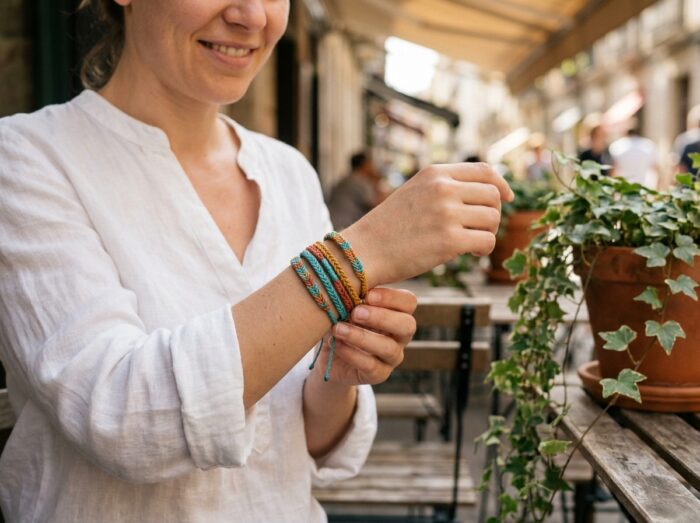
A cord bracelet is defined by a flexible textile structure (cotton, polyester, braided nylon) that serves as the base for a wrist jewelry piece, with or without added ornamentation. This type of bracelet has existed for decades in costume jewelry, but the demand from women has seen a marked acceleration in recent years, driven by technical, aesthetic, and regulatory factors that go beyond mere fashion trends.
Durable, recycled, or hybrid cord: the technical families that structure the offer
Talking about “cord bracelets” as a single object ignores the segmentation that has developed in this market. Three main families coexist, each addressing a distinct need.
- High-tenacity polyester or braided nylon durable cords: designed for everyday use, they withstand water, sweat, and friction without fading or fraying quickly.
- Cords made from traceable recycled materials: these threads come from ocean plastics or industrial textile scraps, with a documented traceability chain. Their texture differs slightly, often being more matte and grainy.
- Hybrid models combining cord and natural stones or beads: the cord then serves as a flexible support for mineral elements (amethyst, labradorite, citrine, turquoise), creating a piece of jewelry that plays on the contrast between raw material and shine.
This segmentation partly explains why the reasons for the success of cord bracelets cannot be reduced to a question of price. The choice of the cord itself has become a thoughtful act, guided by criteria of durability and skin comfort.

REACH standards and skin allergies: a concrete advantage of cord bracelets for women
European regulations, particularly the REACH framework, increasingly regulate the presence of nickel and certain heavy metals in jewelry worn directly on the skin. Cheap metal bracelets, often made from alloys containing these substances, pose a recurring problem of contact allergies.
The cord bracelet offers a direct alternative. The textile eliminates metal-skin contact over most of the wrist, significantly reducing the risk of dermatitis. For teenagers and women with reactive skin, this is as compelling an argument as aesthetics.
Designers have understood this: when a metal element is added (clasp, medal), it is increasingly often made of surgical stainless steel or nickel-free gold plating. The cord is no longer a “low-end” substitute for metal, but a conscious choice of comfort.
Color palette of cords and fashion trends: why black is declining
Black cord has long dominated the market by default. It went with everything, didn’t visibly get dirty, and remained neutral. This logic is wearing thin.
Earth tones (terracotta, khaki, sand) are gaining ground because they align with the natural clothing palettes that dominate recent collections. A sand-colored cord bracelet worn on a tanned wrist, paired with a linen outfit, creates a chromatic continuity effect that black cannot offer.
Powder pink and natural stone tones (gray quartz, sage green) complement this evolution. The choice of cord color is becoming a full-fledged style element, comparable to the choice of leather or metal in traditional jewelry.
Stacking as a multiplier factor
Stacking, which involves layering multiple bracelets on the same wrist, mechanically favors cords. Their thinness and flexibility allow for wearing three, four, or five without feeling cluttered. A stack of rigid metal bracelets tires the wrist, while a cord stack remains comfortable all day.
This practice also encourages variation in colors and textures. A terracotta cord with wooden beads, a black braided nylon with a hematite stone, a blue recycled thread with a small steel pendant: the combination creates a personal style without a heavy investment.

Personalization and natural stones: what transforms an accessory into a personal jewel
Personalization is the tipping point between a bracelet bought for convenience and a piece of jewelry that carries meaning. On a cord, the options are numerous: engraving on a plaque, choosing a specific natural stone, selecting the type of knot (sliding, macramé, flat weaving).
Semi-precious stones like amethyst, labradorite, or citrine are frequently associated with spiritual meanings or wellness virtues. Whether one subscribes to these beliefs or not, they add a narrative layer to the jewelry. A cord bracelet with turquoise chosen for its color and symbolism is no longer an interchangeable accessory.
Custom orders have also seen a notable increase, primarily driven by a female clientele aged 25 to 45. Designers specializing in natural beads are the primary beneficiaries of this trend, as their artisanal expertise perfectly matches this demand for unique pieces.
Price as a gateway, not as the main argument
The cord bracelet remains financially accessible compared to a piece of jewelry made of gold or solid silver. However, reducing its appeal to price would be a misanalysis. What attracts buyers is the combination of a reasonable cost, extensive personalization options, and daily physical comfort. Price opens the door, but it is the quality of the experience that fosters loyalty.
The cord bracelet has established itself in women’s habits through a convergence of factors rarely found in the same accessory: skin comfort, compliance with regulatory requirements, chromatic adaptability to fashion trends, and the potential for artisanal personalization. Its lightness, both literally and figuratively, allows it to fit into very different styles without ever seeming out of place.