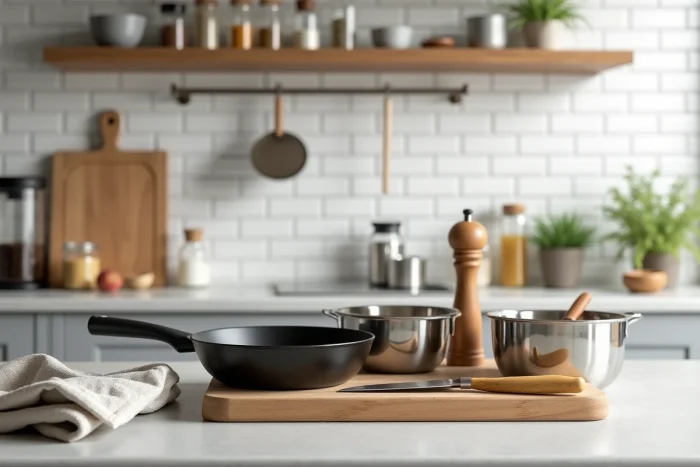
We’ve all opened a cupboard in the midst of preparation to search for an elusive utensil, or cursed a pan that sticks after six months. Culinary equipment isn’t just a long list of purchases: it’s a choice of materials, formats, and priorities that shapes every meal. It’s better to have three reliable tools than a drawer full of unusable gadgets.
Food-contact materials: what the label doesn’t always say
When buying a frying pan or saucepan, we look at the price, the brand, and sometimes the design. The material of the coating often takes a back seat, even though it determines the lifespan and safety of use.
In recent years, several manufacturers like De Buyer and Matfer have offered ranges without PFAS or PFOA, compliant with Regulation (EC) No. 1935/2004 on materials intended to come into contact with food. This European regulation imposes traceability of coatings and limits controversial substances (perfluorinated compounds, bisphenols).
On the ground, you can find all the equipment offered by 75cl to compare ranges and verify these compliances before purchase. The LFGB mention or the French NF standard on food-contact materials remain the most reliable benchmarks when hesitating between two references.
18/10 stainless steel, raw cast iron, and carbon steel do not have coating issues since they have none. A utensil without a chemical coating ages better and regenerates with use (seasoning for cast iron and carbon steel). Feedback varies on the comfort of use initially, as the seasoning process can sometimes be discouraging, but the long-term results more than compensate.

Kitchen knives: three blades are enough
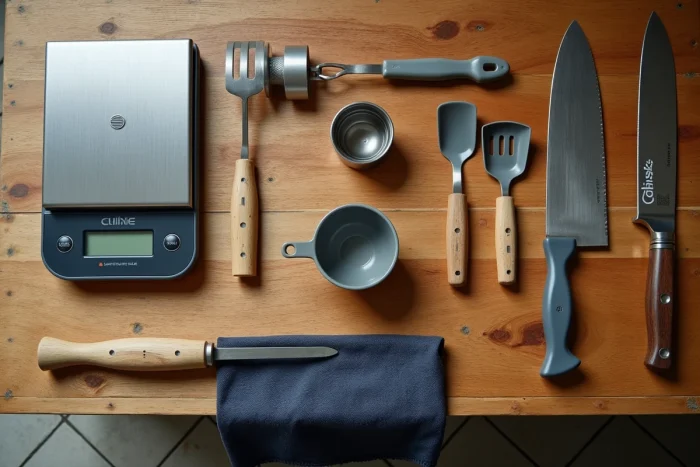
You can fill a magnetic block with ten knives without ever using half of them. In practice, three knives cover almost all tasks in home cooking.
- The chef’s knife (or slicing knife), with a blade between 18 and 21 cm, is used for slicing, chopping, dicing vegetables, and slicing meat. It’s the main tool, the one to focus the budget on.
- The paring knife, with its small 8 to 10 cm blade, takes over for precision tasks: peeling, turning a vegetable, trimming a fillet.
- The serrated bread knife slices without crushing the crumb. It’s also useful for tomatoes and thick-skinned citrus fruits.
A good honing steel completes the trio. Contrary to popular belief, a well-sharpened knife causes fewer accidents than a dull blade that requires force, leading to slips. Running the blade along the steel before each cutting session is enough to maintain the edge daily.
Steel or ceramic for blades
Stainless steel remains the standard for its resistance to corrosion and easy maintenance. Carbon steel offers superior sharpness but rusts if left damp. Ceramic cuts finely but can break on a bone or hard vegetable. For versatile use, stainless steel or carbon steel are the most durable choices.
Stainless steel and cast iron cookware: choose based on actual use
Rather than buying a complete set of eight pieces, it’s better to select each item based on what you actually cook.
A 28 cm stainless steel frying pan handles searing, vegetable stir-fries, and high-temperature cooking. It’s safe for both the oven and the dishwasher. For eggs, pancakes, and delicate foods, a pan with a mineral or ceramic coating (verified to be PFAS-free) complements the duo well.
Two saucepans cover most needs: one 16 cm for sauces, rice, and small quantities, and one 20 cm for soups, pasta, and boiled vegetables. Made of cast iron or thick stainless steel, they distribute heat evenly and withstand years of intensive use.
Stockpot or cast iron Dutch oven
For braising, stewing, and long cooking, the cast iron Dutch oven is hard to replace. Its weight ensures thermal inertia, maintaining a stable temperature over low heat. You can move it from the stove to the oven without changing containers, simplifying recipes into a single step.
Compact small appliances: prioritize multifunctionality
In urban kitchens where every inch of counter space counts, accumulating specialized appliances quickly becomes a space issue. Recent reports on home equipment highlight a clear trend: compact two-in-one or three-in-one appliances (heated blender, multifunction robot, combined air fryer oven) have become the primary purchasing criterion in the small kitchen appliance category.
Before investing, ask a simple question: how many times a week will this appliance be used? An immersion blender replaces a blender and a vegetable mill in most cases. A convection oven with steam function covers cooking needs without adding a separate steamer.
Energy efficiency and energy label
Electric consumption is part of the real cost of an appliance. Induction consumes significantly less than gas or ceramic hobs for the same heating power, thanks to better efficiency (heat is produced directly in the bottom of the container). For the oven, models with reinforced insulation and high energy class reduce the bill in the long run.
Well-chosen culinary equipment consists of a few solid pieces, suited to the size of the kitchen and the dishes you actually prepare. It’s better to postpone the purchase of a trendy gadget to invest in a decent chef’s knife or a stainless steel pan that will last a decade.