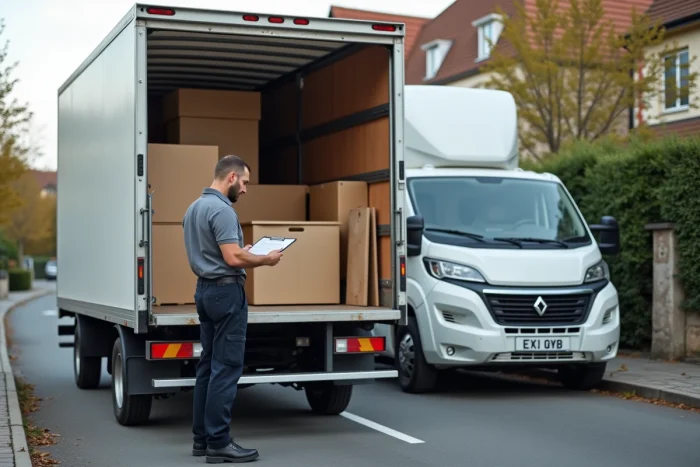
Between the compact van and the heavy truck, the 10 m3 truck occupies a special place in the range of utility vehicles. Its advertised volume suggests that simply filling it will allow you to exploit its full potential. The reality is more nuanced: useful volume, maximum load, and regulatory constraints define a transport perimeter that must be measured before loading the first box.
Actual volume vs. advertised volume: the figures for the 10 m3 truck
The technical specifications of a 10 m3 van show interior dimensions close to 2.80 m in length, 1.75 m in width, and 1.80 m in height. The product of these three measurements indeed gives a geometric volume close to 10 m3.
| Parameter | Indicative value (diesel) | Indicative value (electric) |
|---|---|---|
| Geometric volume | ~10 m3 | ~10 m3 |
| Actually usable volume | ~8 m3 (80% rule) | ~8 m3 (80% rule) |
| Payload | Approximately 1 to 1.5 t | Potentially higher (GVW up to 4.25 t, license B) |
| Required license | B | B (with appropriate training) |
| Seating capacity | 3 | 3 |
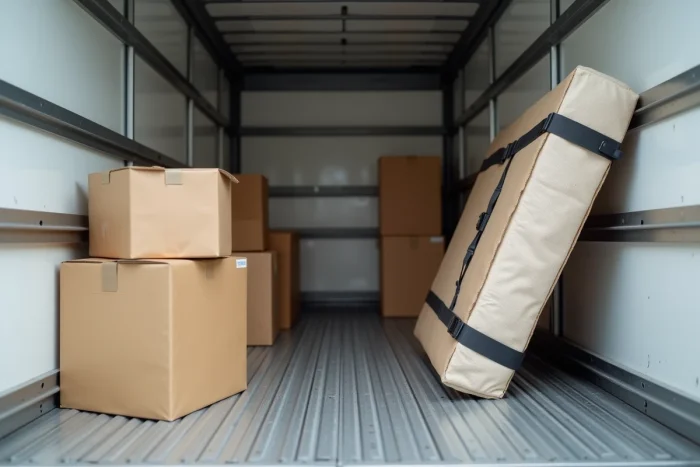
The most underestimated data in this table is the line “actually usable volume.” In practice, only about 80% of the theoretical volume is usable: the irregular shape of furniture, dead spaces between boxes, and securing requirements absorb the rest.
To fully understand the capabilities of a 10 m3 truck, one must therefore reason in terms of 8 m3 effective rather than the 10 m3 from the manufacturer’s specifications.
Payload of the 10 m3 truck: the invisible limit
The common reflex is to assess whether everything “fits” in the truck. The better question is: does everything “weigh” within the limits?
A 10 m3 diesel van offers a payload ranging from 1 to 1.5 tons. This ceiling seems comfortable for a studio of 20 to 30 m2 (double bed, two-seater sofa, refrigerator, washing machine, and a few boxes). It becomes critical as soon as the load contains dense items.
- A box of books or dishes easily weighs 25 to 30 kg, and a few dozen boxes of this type can consume a significant portion of the payload without filling the volume.
- Heavy appliances (washing machine, dryer, combined refrigerator) quickly add several hundred kilos on their own.
- Professional tools (craftsmen, construction sites) reach the mass threshold well before saturating the available space.
Technical guides clearly summarize: monitor the weight before the volume for dense loads. A 10 m3 truck that is half empty but overloaded in mass exposes one to a violation, premature brake wear, and degraded road behavior.
10 m3 electric truck: what European regulations change
Recent European regulations introduce a break for zero-emission utility vehicles. A 10 m3 electric van can, under certain conditions, have its GVW increased to 4.25 tons while remaining drivable with a B license. The trade-off: appropriate training for the driver.
The concrete effect is direct. By increasing the GVW without changing the license category, the electric vehicle frees up additional payload compared to a diesel of the same volume. For a craftsman who regularly transports heavy materials, the difference in available load can influence the choice of vehicle.
Most rental listings do not yet mention this possibility. Catalogs display the same volume and interior dimensions, without distinguishing the actual payload according to the engine type. One must explicitly ask for the GVW and the empty weight to compare.
Moving with a 10 m3 truck: housing correspondence and practical limits
Rental companies generally associate the 10 m3 with a studio or small apartment of 20 to 30 m2. This correspondence is based on a typical load: double bed, two-seater sofa, refrigerator, washing machine, television, and about twenty boxes.
This estimate holds if three conditions are met:
- Bulky furniture can be disassembled (bed, wardrobe, table). A monobloc piece of furniture consumes a disproportionate volume compared to its bulk once disassembled.
- Boxes are stacked evenly to reduce dead spaces. The heaviest at the bottom, the lightest on top, without exceeding the height of the loading floor.
- The total weight remains under the payload. For a normally furnished 30 m2 apartment, one generally stays within the envelope. Beyond that (dense two-room apartment, significant library), a second trip or a 12 m3 vehicle becomes necessary.
The 10 m3 van sits between the 6 m3 (limited to a few pieces of furniture and boxes) and the 12 m3 (which accommodates a complete two-room apartment). Choosing the size just below one’s actual need is the main source of unpleasant surprises on loading day.
External dimensions and driving constraints
Size and maneuverability
With a total length of about 5.50 to 6 meters depending on the model, the 10 m3 remains maneuverable in the city. It fits in most underground parking lots, provided one checks the authorized height clearance: the loaded vehicle often exceeds 2.50 m, which excludes some residential parking limited to 1.90 m.
License and regulations
With thermal engines, the GVW remains under 3.5 tons: a B license is sufficient, without any particular seniority restrictions beyond one year of possession. The rental vehicle’s insurance generally covers one main driver and one additional driver declared in the contract.
The 10 m3 remains the largest utility vehicle accessible without additional training in diesel. Beyond that (20 m3, 30 m3), one transitions to heavy trucks requiring a C license, with very different driving, parking, and toll constraints.
The actual capacity of a 10 m3 truck boils down to two ceilings that must be checked in parallel: 8 m3 of usable volume and 1 to 1.5 tons of payload in diesel. Recent European regulations redistribute the cards for electric versions, but rental listings have not yet caught up with this evolution. Weighing your load, not just measuring it, remains the most reliable precaution before hitting the road.