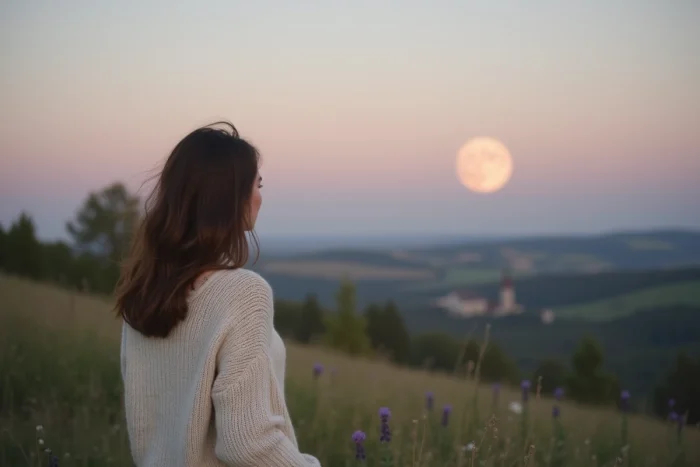
No pink hue appears during the full moon of April, despite an evocative name popularized since the 19th century in North America. Lunar cycles, although considered regular, experience variations in name and interpretation depending on cultures and eras. The influence of the Moon on calendars, agricultural traditions, or beliefs reveals the complexity of the links established between astronomical phenomena and human societies.
The phases of the Moon: understanding their influence and symbolism
To mention the full moon is to examine the workings of a millennia-old cycle. It is distinguished from the Blood Moon or the Blue Moon, which pertain to other phenomena. The April full moon, nicknamed “Pink Moon,” marks the true shift towards spring: in the Christian calendar, it even sets the date for Easter according to a rule from the Council of Nicaea. It is hard to imagine a more deeply rooted tradition.
Each phase of the moon corresponds to a symbolism that goes beyond the mere astronomical fact. New moon, first quarter, full moon, last quarter: each of these stages is laden with meanings. The full moon concentrates hopes and projections. For some, it is associated with fertility or renewal, for others with healing, a time for assessment or launching. Over the ages, it traverses cultures, infiltrates customs, establishes itself in rituals, and even invites itself into contemporary magical thinking.
So why is it called the “Pink Moon”? No magenta-toned halo lights up the April night. The explanation goes back to a flower, phlox, which blankets North American landscapes as the nice weather returns. It is therefore neither an optical illusion nor an astrologer’s whim − but, as told in the meaning and origin of the pink full moon, a story of botany, natural markers, and rituals woven over several generations. The Pink Moon charts its course between nature, spirituality, and collective heritage.
Why is it called the pink full moon? Origins, beliefs, and scientific realities
The fascination surrounding the Pink Moon returns every spring, amplified by social media and the press. Yet, there is not the slightest variation in hue upon its appearance. This name owes everything to Native American tradition and the blooming of pink phlox, which carpets the fields at this time of year. Later, the Farmer’s Almanac adopted and popularized the expression among the North American public.
This event takes on a whole new dimension when looking at the range of traditions. For many, April is the season of renewal. The full moon then serves as a marker for celebrations around fertility, healing, or the return of light. Among spirituality enthusiasts, it is linked to inner blooming, gratitude, and grounding. In China, it is referred to as the Peony Moon; among Wiccans, it is the Seed Moon. Each tradition gives it its own symbolic hues.
Scientifically, nothing distinguishes the April full moon from its counterparts. Its light is identical. What makes the difference is the ability of humans to blend observation, narrative, and collective imagination. The April full moon thus becomes an intersection: on one side, the rigor of science, on the other, the vibrant energy of myths and practices passed down through time.

Exploring the secrets of the Pink Moon: impact on our emotions and an invitation to observation
The Pink Moon is not just a folkloric anecdote. This moment of spring prompts us to question our intimate connection with the sky, as a call for balance and transformation. In the collective imagination, this April full moon evokes harmony, invites us to revisit our relationships, and marks the starting point of a new cycle.
Scientists have not remained indifferent: according to a team from the University of Washington, the full moon could influence sleep quality, making our nights more fragmented and our cycles slightly shorter. Discussions remain open, but this avenue intrigues and fuels the fascination for the moon and its effects on our daily lives.
For some cultures, the April full moon is accompanied by symbolic stones that extend its reach: moonstone is prized for peace, carnelian for enhancing creativity, rose quartz for encouraging love and healing, amethyst for deep calming. All these elements enrich ritual practices and give depth to the Pink Moon.
This event endlessly attracts enthusiasts and the curious. Everywhere, observation sites like Parco del Portello or Monte Stella become gathering places to contemplate this celestial spectacle. In the language of the stars, the Pink Moon particularly resonates with Libra, the sign of Venus: an ideal time to reinvent one’s relationship with oneself and others, to grant oneself a moment of gratitude, or to meditate on one’s transformations. And every spring, this same satellite, now a silent marker, returns, carrying enigmas and so many new hopes.