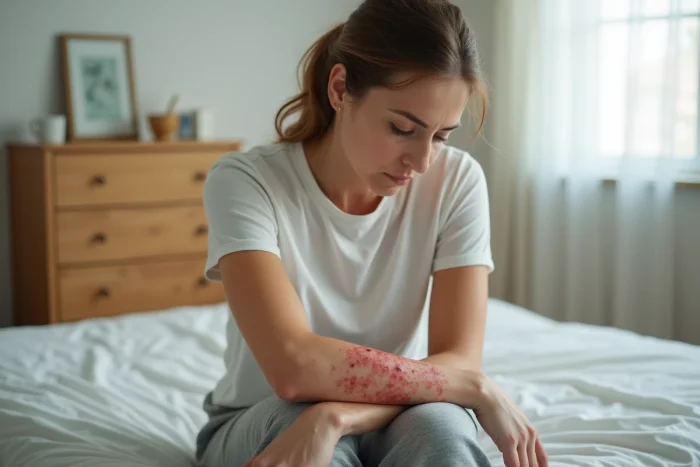
An isolated button rarely attracts attention, but the sudden multiplication of lesions across the body escapes the usual logic of common skin conditions. Certain infectious diseases or allergic reactions can cause widespread manifestations, sometimes accompanied by general signs.
The triggering factors far exceed the scope of simple childhood infections and concern all age groups. Underlying pathologies, medications, or environmental agents are among the causes to consider. Identifying associated symptoms and knowing the criteria that require a consultation accelerates management and limits potential complications.
Understanding the rash of buttons all over the body: what are we really talking about?
Seeing one’s skin suddenly covered with multiple lesions, from the face to the legs, is not trivial. The rash of buttons all over the body is not limited to a few transient redness. It involves the simultaneous appearance of buttons, red patches, blisters, or edema, often accompanied by sometimes unbearable itching. Arms, back, thighs, chest: no area is truly spared. This heterogeneous dermatological picture is concerning, and rightly so.
Every detail points to the cause. A sudden outbreak with fierce itching does not have the same meaning as a rash accompanied by fever or diffuse pain. The appearance of the lesions, their distribution, the speed of evolution, the general state of the patient: everything matters. The origins vary, from an allergy to a medication to a viral infection or an autoimmune disease. Even the context, such as recent contact with an animal, taking new medications, or a flu episode, guides the diagnosis.
In this situation, caution prevails. As soon as the fever rises, the general condition deteriorates, or the lesions evolve rapidly, action must be taken. The expression rash of buttons all over the body should raise alarms: it is part of those signs that the skin sends to indicate a deep imbalance. To explore these warning signals, the article Rash: when to worry? Causes and advice – Pharmidea provides useful insights.
To better understand these manifestations, here’s what is most often observed:
- Skin rashes: patches, buttons, redness, or blisters, generally associated with itching.
- These lesions can affect the face or extend to the entire body.
- They are sometimes accompanied by fever, edema, or a marked feeling of fatigue.
Common causes, signs to watch for, and factors of severity
In the face of a rash of buttons all over the body, the diagnosis resembles a puzzle. The causes are multiple: allergic reactions (food, medication, environmental), viral or bacterial infections, autoimmune diseases, but also stress, insect bites, or contact with an irritating plant. In children, chickenpox, measles, or roseola remain common. Adults, on the other hand, are more often confronted with urticaria, eczema, or secondary reactions to a medication or chronic illness.
The clinical picture goes well beyond simple buttons. Patches, blisters, and sometimes intense itching are observed. Fever or edema may manifest, as well as a general malaise. Certain viral infections, such as chickenpox, measles, or Covid-19, cause diffuse rashes. Bacterial infections (scarlet fever, impetigo) or parasitic infections (scabies) do not spare the skin. Psoriasis, lupus, or other autoimmune diseases also present characteristic dermatological signs.
Here are the situations that should attract attention and the circumstances that may worsen the rash:
- Warning signs: high fever, rapid extension of lesions, edema, significant pain, alteration of general condition.
- Aggravating factors: exposure to heat or cold, prolonged sun exposure, dry skin, consumption of foods rich in histamine, marked stress.
Young children are not immune: diaper rash, due to moisture and prolonged contact with diapers, reflects the diversity of causes. In adults, as in children, close monitoring is essential. Ignoring a generalized skin rash exposes one to unsuspected risks, as the skin often reflects a deeper internal disorder.

When to consult a doctor and what solutions to consider?
The appearance of a rash of buttons all over the body requires attention to signals: sudden onset, rapid extension, fever, edema, pain, general malaise. A localized itching does not always justify a consultation, but red patches, blisters, or general symptoms, especially in infants, the elderly, or immunocompromised individuals, should raise alarms.
In which cases is it necessary to consult a healthcare professional? Here are the situations where one should not delay:
- Consult without delay if the rash spreads, hinders breathing, causes severe pain, or is accompanied by high fever.
- A medical opinion is necessary in case of relapse, chronic illness (psoriasis, lupus), or ineffectiveness of local treatments and hygiene measures.
The general practitioner is the first point of contact. He conducts a detailed examination: distribution of lesions, appearance, context of onset. If necessary, he refers to a dermatologist. Sometimes additional tests are required to distinguish between allergy, infection, autoimmune disease, or reaction to a medication. The diagnosis relies on careful observation of every clinical detail.
The treatment, of course, depends on the identified cause. Antihistamines in case of allergy, local treatments to soothe the skin, avoidance of the responsible substance, specific treatment in case of infection or chronic disease. Regular hydration, avoidance of aggravating factors (heat, cold, irritating products), and monitoring of symptoms form the basis of effective management.
The skin never lies for long. When it is covered with buttons, the entire organism signals an imbalance. Knowing how to listen to these messages can sometimes prevent worsening. Staying attentive is already taking care of one’s health.