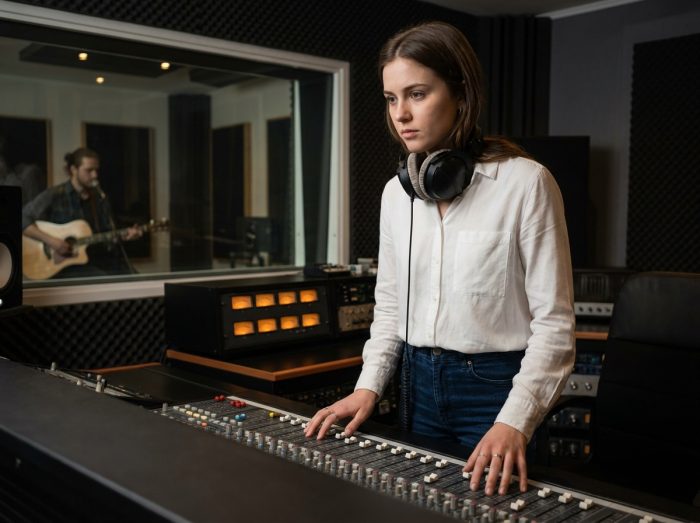
A student playing in their school orchestra and a musician recording in a professional studio do not have the same job. The gestures may look similar, the instrument may sometimes be the same, but the technical demands, the relationship to time, and the pressure of results are completely different. Understanding what separates these two worlds helps better prepare for the transition from one to the other.
What studio work requires that school doesn’t always teach
In class, a piece is rehearsed until mastered. In the studio, a usable take must be delivered in a limited number of passes. This time constraint changes the way of playing: every note counts, every silence too.
The most destabilizing difference concerns listening. In a classroom, sound spreads through space. Under studio headphones, the musician hears every detail of their playing, amplified, without the benevolent filter of natural acoustics. Many graduates discover flaws at this moment that they had never perceived before.
Another gap concerns collaboration with a sound engineer. In school, the teacher guides the interpretation. In the studio, it’s a technician who asks to replay a passage for acoustic reasons, not musical ones. Accepting this logic requires a complete learning process, and it is useful to understand how training prepares for professional studios by integrating these cross-disciplinary skills from the curriculum.

Internships in live production and first concrete projects
Have you ever noticed that some musicians graduate with a solid diploma but no recording experience? This gap explains why the most effective programs incorporate real-world immersions.
In Belgium, recently, hybrid programs require mandatory internships in live production. The principle: place the student in a studio or on a set for several weeks, with concrete deliverables to submit. This is not an observation internship. The student participates in sessions, prepares tracks, and corrects takes.
In Quebec, the approach differs. Mentorship programs connect musicians from educational backgrounds with active professionals, according to a report from the Conseil des arts et des lettres du Québec published in March 2025. These collaborations sometimes lead to participation in emerging festivals, which constitutes a credible first line on a CV.
What these immersions concretely change
- The student learns to manage the pressure of a paid session, where every hour in the studio has a real cost for the producer
- They discover the technical vocabulary used by sound engineers, directors, and artistic directors
- They build a professional network even before finishing their training, which reduces the post-graduation isolation period
Without this early exposure, the transition from school to studio relies on luck or personal contacts. Both are fragile.
Professional status and economic reality after graduation
With the diploma in hand, the question is no longer musical. It becomes administrative and financial. What status to choose? How to finance the first years, often unprofitable?
In France, a recent reform of the intermittent entertainment status strengthens support for professional transition for musicians graduating from public schools. The extension of grants to independent recording studios opens a possibility that did not exist before: being paid to work in the studio without going through a performance contract.
This evolution is not trivial. It recognizes that studio work constitutes a full-fledged professional activity, distinct from concert performance. For a young musician, this means they can legally accumulate recording hours in the calculation of their rights.
Non-musical skills to acquire
The conservatory or music school trains performers. The studio also requires additional skills that no one teaches in a music theory class:
- Knowing how to read and negotiate a session contract, even a basic one
- Understanding the concepts of copyright and neighboring rights applicable to a recording
- Managing their billing and social security, especially under intermittent status
- Communicating with non-musician professionals (producers, managers, labels)
Ignoring these aspects means entrusting one’s career to others. Many talented musicians stagnate due to a lack of mastery over this administrative side.
Building a musician-studio path without a unique model
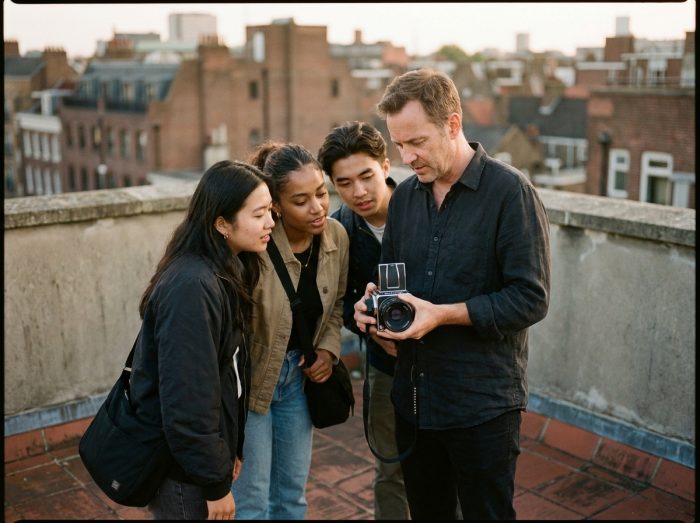
There is no typical trajectory. Some go directly from school to the studio thanks to a contact made during an internship. Others spend years performing before turning to recording. Still, others continuously combine both.
What distinguishes successful paths is the ability to accumulate concrete work evidence. A portfolio of recordings, even modest ones, carries more weight than a diploma alone during a studio audition. Artistic directors listen to tracks, not report cards.
Testimonials from Quebec musicians post-pandemic confirm this trend: the decline in opportunities in large school ensembles has pushed many graduates toward sessions in independent studios, often through improvised jams that turn into lasting collaborations, according to the Observatoire de la culture et des communications du Québec.
The transition from school benches to professional studios is not just a linear progression. It is a change of framework, rhythm, and rules. Training lays the groundwork, the field shapes the profession. Musicians who successfully make this transition are those who accept to become beginners again in an environment where their diploma guarantees nothing, but where their preparation makes all the difference.